
In the early stages of a business, manual operations feel manageable, and the need for automation tools like Zoho Flow is often not immediately visible. Teams rely on emails, spreadsheets, and basic tools to move work forward. Tasks are handled individually, and coordination happens through follow-ups or quick communication. At a smaller scale, this approach works. Processes are flexible, and teams adapt quickly without needing structured systems.
However, as operations grow, this model starts creating friction. Tasks move between departments without visibility. Approvals depend on reminders. Data gets duplicated across tools instead of flowing through a connected system.
Over time, these small inefficiencies begin to compound. What once felt manageable turns into delays, confusion, and inconsistent execution. At this stage, the cost of not automating becomes visible. It is not a single expense but a combination of lost time, missed opportunities and operational inefficiencies that slow down growth.
Table of Contents
Manual operations create hidden costs
Manual operations rely on individuals to move tasks forward. Every step depends on someone remembering to act, update, or communicate.
A lead enters the system, but follow-up depends on availability. A deal closes, but invoicing requires coordination between teams. A support issue gets resolved, but insights remain isolated instead of improving future responses. These gaps do not appear as direct costs but create inefficiencies across the system.
Time is spent on repetitive tasks like data entry, status updates and follow-ups. Errors increase when data is handled manually. Communication becomes inconsistent as teams rely on scattered channels. Over time, these inefficiencies reduce overall productivity and affect customer experience.
If your business is already experiencing these gaps, you can schedule a quick consultation here: https://calendly.com/anuj-himcos/30min

Why inefficiency increases without automation
As business activity increases, manual workload increases at the same rate.
Every new lead, order, or customer interaction adds more tasks. Without automation, teams spend more time managing work instead of completing it.
Another major issue is dependency on individuals. Processes are not system-driven, so execution varies based on who is handling the task. When workloads increase or team members change, consistency drops. This leads to bottlenecks across departments. Tasks get delayed, approvals take longer and coordination becomes harder.
As a result, scaling operations become difficult because the system is not designed to handle increased volume efficiently.
What Zoho Flow does differently
Zoho Flow connects different applications and automates workflows between them.
Instead of manually transferring data or triggering actions, the system automatically executes the next step based on defined conditions. When one event occurs, the next action follows without delay. This creates a continuous flow of work across systems.
For example, when a lead is captured, it can be assigned automatically. When a deal is closed, invoicing can begin instantly. When a support ticket is updated, relevant teams are notified in real time. This removes dependency on manual coordination and improves execution speed across departments.
Cost of not automating: Manual vs automated
Time loss
Manual operations require repeated effort for routine tasks. Teams spend hours on follow-ups, updates and coordination.
Automation reduces this by handling repetitive actions automatically. This allows teams to focus on tasks that require decision-making and strategy.
Over time, this shift significantly improves productivity.
Revenue impact
Missed follow-ups and delayed actions directly affect revenue.
When leads are not contacted on time or opportunities are not tracked properly, conversion rates drop. Manual systems often fail to maintain consistency in follow-ups.
Automation ensures that every lead is assigned, tracked, and followed up without delay. This improves conversion predictability.
Error rate
Manual data handling increases the chances of mistakes.
Incorrect entries, missed updates, and inconsistent data create issues across teams. These errors affect reporting and decision-making.
Automation reduces errors by transferring data directly between systems, maintaining consistency across workflows.
Visibility gaps
Manual systems lack real-time visibility.
Teams rely on updates, reports, or meetings to understand progress. This delays decision-making and reduces responsiveness.
Automation provides real-time tracking across systems. Managers can view live data, improving control and planning.
Scaling challenges
Manual processes become harder to manage as volume increases.
Adding more work requires more effort, more coordination and often more people. This increases operational cost without improving efficiency.
Automation allows businesses to handle higher workloads without increasing complexity. Systems manage execution consistently, even as volume grows.
Real use cases of Zoho Flow
Automation using Zoho Flow applies across different business functions.
In sales, lead capture from websites or campaigns can trigger automatic assignment and follow-ups. This reduces response time and improves engagement. In finance, deal closure can trigger invoice generation and payment tracking without manual coordination. This improves billing efficiency.
In customer support, ticket updates can notify relevant teams instantly. This improves response time and issue resolution. These use cases show how automation improves coordination and reduces delays across departments.
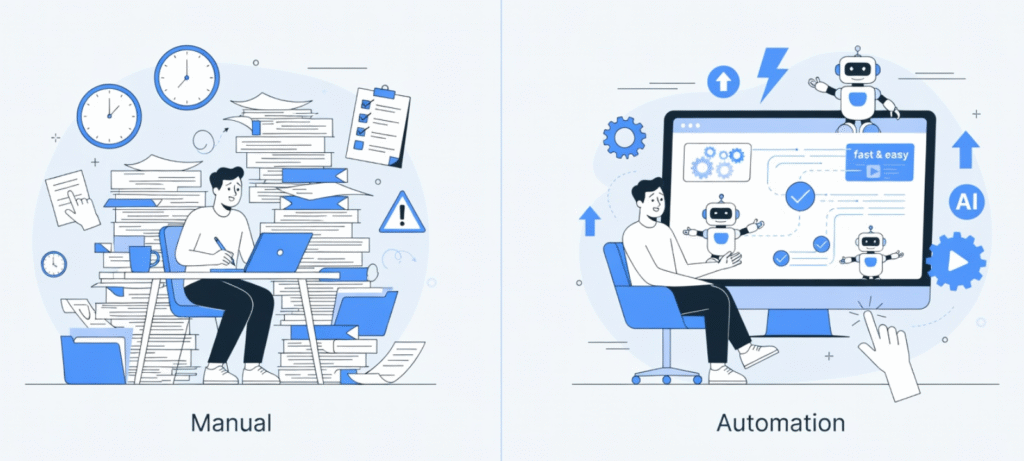
Example workflow comparison
Manual Workflow:
Lead captured → manually assigned → follow-up delayed → deal update missed → invoice created late
Automated Workflow:
Lead captured → auto-assigned → follow-up triggered → deal tracked → invoice generated instantly
The difference lies in consistency and speed. Automated workflows reduce dependency on individuals and create predictable execution.
Implementation approach by Himcos
Himcos approaches automation by focusing on business workflows rather than tools.
The process starts with identifying repetitive tasks and operational delays. Based on this, workflows are designed to reduce manual effort and improve efficiency.
Applications are connected using Zoho Flow, and automation rules are configured based on real execution patterns. Testing is conducted to validate workflows before full deployment.
After implementation, continuous monitoring and optimization improve system performance over time.
This structured approach helps businesses move from manual dependency to system-driven operations. To explore how this can work for your business, reach out through this contact form: https://himcos.com/contacts-simple/
Business impact of automation
Automation leads to measurable improvements across operations.
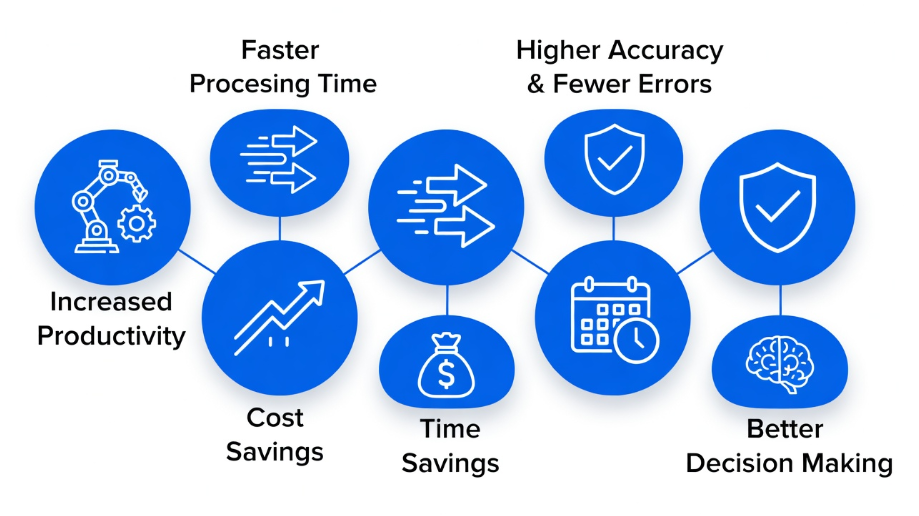
Task execution becomes faster as manual steps are reduced. Follow-ups become consistent, improving conversion rates. Data accuracy improves due to reduced manual handling.
Teams spend less time on repetitive work and more time on strategic activities. This improves productivity and decision-making.
Over time, automation creates a more controlled and predictable system, supporting business growth.
Engagement models for automation
Himcos provides different engagement models based on business needs.
Fixed-cost implementation works for clearly defined workflows with specific requirements. Hourly consulting supports businesses looking for ongoing improvements and optimization.
Full automation setup is used when businesses transition from manual systems to integrated workflows.
Each model aligns with different levels of complexity and helps manage cost effectively.
If you’re unsure which model fits your business, you can book a consultation here: https://calendly.com/anuj-himcos/30min or directly submit your requirements here: https://himcos.com/contacts-simple/
Key takeaways
- Manual operations create hidden costs over time.
- Automation reduces time, errors, and operational dependency.
- Zoho Flow connects systems and improves workflow execution.
- Business performance improves with structured processes.
- Implementation approach determines actual results.
Final insight
The cost of automation is visible and measurable.
The cost of not automating builds silently through inefficiencies, delays and missed opportunities and is significantly higher over time.