
Workflow automation has been a core part of business operations for years. Systems were designed to connect applications, reduce manual effort, and standardize execution. However, in 2026, a clear limitation has emerged. Automation alone does not solve operational complexity.
Most workflows still operate on predefined rules. These workflows execute tasks efficiently but lack the ability to interpret context, adapt to variability, or make decisions. Business environments are dynamic. Inputs vary, data is often unstructured, and decisions require contextual understanding. This gap is now addressed through AI integration in Zoho Flow. With AI capabilities powered by Zia, Zoho Flow is evolving into an intelligent execution layer that enhances how AI workflows operate across systems.
By embedding intelligence directly into automation pipelines, workflows can now analyze inputs in real time, extract meaningful insights, and trigger context-aware actions. This reduces manual intervention and enables faster, more accurate decision-making across departments. As a result, organizations can move beyond static automation toward adaptive systems that continuously learn and improve with each interaction.
Table of Contents
What is Zoho Flow?
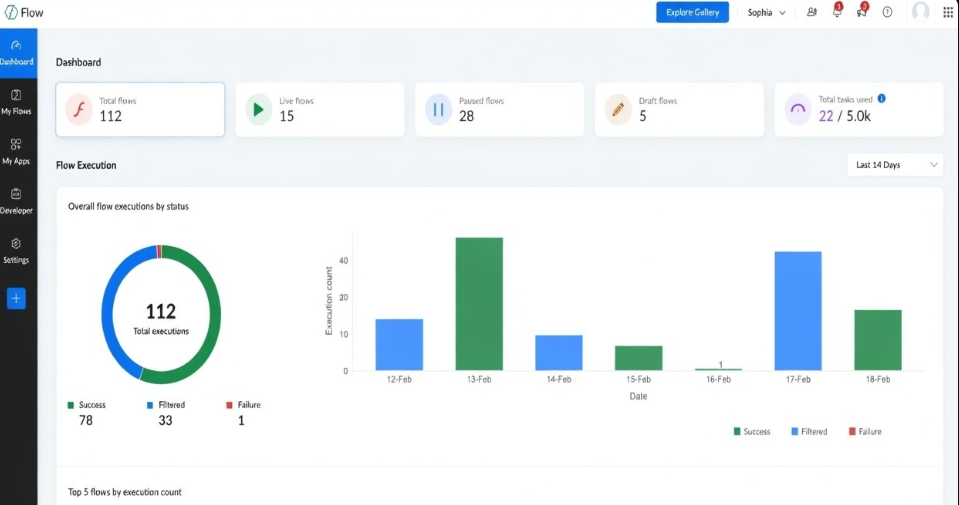
Zoho Flow is a workflow automation platform designed to integrate applications and automate business processes.
Traditionally, Zoho Flow has been used to:
- Move data between systems
- Trigger actions based on conditions
- Connect CRM, finance, and operational tools
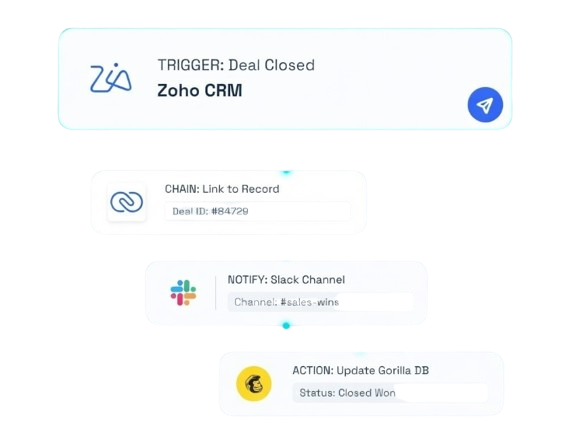
For example, a new lead submission creates a record in CRM, assigns a task, and sends a notification. A completed transaction triggers invoice creation and reporting updates. While effective, these workflows relied on static configurations. Any process change required manual updates, limiting flexibility and scalability. The introduction of AI in 2026 changes this foundation.
What changed in 2026?
The evolution of Zoho Flow is not a feature update. It is a structural shift in how workflows are designed and executed.
Intent-based workflow design
Workflow creation has shifted from manual configuration to intent-driven design. Instead of defining each trigger and action, the outcome is defined, and AI builds the workflow structure.
This reduces implementation complexity and accelerates deployment timelines.
AI embedded inside workflows
AI is now part of the execution layer. Workflows process unstructured inputs such as emails, documents, and conversations.
Tasks like summarization, classification, and response generation are handled within the workflow itself. Automation expands from structured data handling to intelligent processing.
Context-aware execution
Traditional workflows follow fixed logic. AI-driven workflows evaluate multiple variables before executing actions.
Customer history, urgency, and behavioral data influence decisions. This results in workflows that adapt dynamically instead of following rigid paths.
Unified AI ecosystem
Data across CRM, finance, operations, and external tools contributes to workflow decisions.
This creates a connected environment where workflows operate with full business context, improving accuracy and consistency.
Why traditional workflows fail
As business complexity increases, the limitations of rule-based automation become more visible. Static workflows fail when inputs fall outside predefined conditions. Unstructured data remains unprocessed. Continuous manual updates are required to maintain relevance.
Dependence on technical teams slows execution. Over time, manual workarounds increase, reducing system efficiency. The result is partial automation instead of true operational improvement.
Shift to AI-driven workflows
The approach to automation in 2026 prioritizes intelligence over static rules. Instead of defining every step, outcomes are defined and AI determines execution. This reduces system complexity while increasing adaptability.
AI-driven workflows:
- Interpret inputs instead of just processing them
- Adjust execution based on context
- Reduce dependency on manual intervention
This shift is essential for building scalable systems.
AI workflow framework
A structured AI workflow operates across three layers:
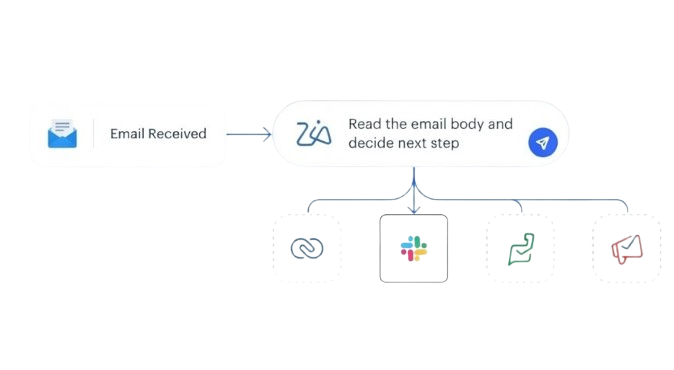
Input layer
Data enters from CRM systems, forms, emails, and third-party applications.
Intelligence layer
AI processes data, interprets context, and determines the next action.
Execution layer
Actions are performed across systems such as record updates, communication triggers, and reporting.
Within Zoho Flow, these layers function as a unified system, enabling seamless execution.
Real business impact
AI integration within workflows delivers measurable outcomes. Customer communication becomes faster and more consistent. AI-generated responses ensure timely engagement while maintaining context. Sales processes improve through automated lead qualification and prioritization. High-value opportunities receive immediate attention.
Operational workflows become resilient. Systems adapt to variations without manual updates, reducing delays and errors. Data consistency improves across departments, leading to better reporting and more informed decision-making. These improvements directly impact efficiency, conversion rates, and operational clarity.
To explore how this applies to your business workflows, you can schedule a consultation here:
https://calendly.com/anuj-himcos/30min
Or reach out directly through the contact form: https://himcos.com/contacts-simple/
How Himcos implements AI workflows
Himcos follows an architecture-first approach to AI workflow implementation. The focus is on system design, not isolated automation. The process begins with mapping business workflows and identifying where AI creates measurable impact. In healthcare organizations, workflows manage patient journeys from initial interaction to billing. AI handles inquiry summarization, routing, and follow-ups, reducing manual coordination.
In automotive businesses, workflows connect lead management, communication, and inventory systems. AI improves data accuracy, automates engagement, and increases visibility across the sales pipeline. This structured approach ensures that AI capabilities align with real business processes, resulting in scalable and consistent performance.
Additionally, AI-driven analytics can uncover customer preferences and buying patterns, enabling more personalized marketing and sales strategies. By integrating predictive insights, businesses can anticipate demand, optimize inventory levels, and reduce operational inefficiencies. Over time, these intelligent workflows not only enhance customer satisfaction but also empower teams to focus on high-value interactions, driving sustainable growth and competitive advantage.
To explore how this applies to your business workflows, you can schedule a consultation here:
https://calendly.com/anuj-himcos/30min
Or reach out directly through the contact form:
https://himcos.com/contacts-simple/
Why this matters in 2026
AI-driven workflows are becoming essential for modern operations. Organizations relying only on traditional automation face increasing inefficiencies. Static systems fail to adapt, leading to delays and reduced effectiveness.
AI-enabled workflows introduce adaptability, speed, and accuracy. Systems operate with context and respond to dynamic conditions. This shift defines operational efficiency and competitive advantage in 2026.
Key takeaways
AI in Zoho Flow transforms automation into intelligent execution systems.
It enables:
- Context-aware decision-making
- Processing of unstructured data
- Seamless integration across business functions
The result is reduced manual effort, improved accuracy, and scalable operations.
Implement AI workflows with Himcos
AI capabilities alone do not deliver results without structured implementation. Himcos designs and implements AI-powered systems using Zoho Flow, aligned with business processes and operational requirements.
Organizations moving from rule-based automation to intelligent workflows require a system-first approach. Consult Himcos to build AI-driven workflows that improve execution, reduce operational complexity, and deliver measurable business outcomes.