

The first 90 days of a Zoho implementation define whether the system becomes a structured growth layer or an operational burden. Businesses adopt platforms like Zoho CRM and Zoho One expecting better visibility, process control, and predictable revenue tracking.
However, early-stage outcomes often look very different. Teams continue using spreadsheets, reports fail to reflect actual performance, and system usage declines. What begins as a structured initiative gradually turns into a disconnected setup.
This pattern is consistent across industries. The problem is not the software. The problem lies in how implementations are designed and executed during the initial phase.
If you’re planning your implementation, you can directly book a strategy call here:
https://calendly.com/anuj-himcos/30min
Table of Contents
What causes Zoho Implementations to fail in the first 90 days?
Zoho implementations fail when systems are built without aligning them to actual workflows. Applications like Zoho CRM, Zoho Books, and Zoho Flow are powerful individually, but without a defined structure, they operate in isolation.
In many cases, CRM pipelines are created without a clear sales journey. Leads are captured, but qualification is unclear. Deals move across stages, but those stages do not represent real buying behavior.
Zoho implementation refers to configuring systems like Zoho CRM based on business processes, structured data, and controlled automation logic so that operations and reporting reflect real workflows.
Without this alignment, the system becomes a data entry layer rather than a decision-making system.
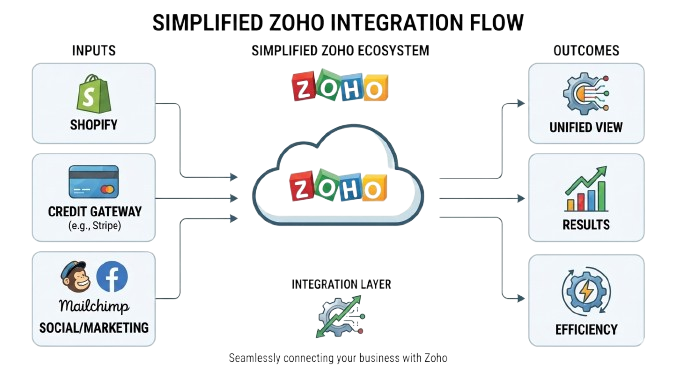
Key observations from early failures
Most Zoho failures in the first 90 days are not caused by missing features. They result from missing structure.
- Systems are configured quickly, but without defining how the business operates
- Workflows do not match real processes
- Data lacks consistency and validation
- Automation behaves unpredictably
Another common observation is premature complexity. Multiple workflows, integrations, and custom fields are introduced early without validation.
Instead of improving efficiency, this creates confusion and reduces adoption.
A structured implementation approach eliminates these gaps by aligning system design with business logic from the beginning.
Root causes behind these failures
The reasons behind early failure are structural.
The absence of sales process design leads to inconsistent usage. Without clearly defined stages and ownership, teams interpret the system differently, which impacts reporting accuracy.
Weak data architecture further compounds the issue. Duplicate fields, inconsistent naming, and lack of validation make it difficult to maintain clean and usable data.
Automation without logic introduces confusion. Workflows are created based on features rather than real conditions, resulting in incorrect triggers and unnecessary actions.
Ownership gaps also contribute to failure. Without a defined system owner, implementation decisions drift away from business needs.
Finally, unstructured setups that prioritize speed over clarity lead to systems that require significant rework later.
The 7 Costliest mistakes in the first 90 days
1. CRM setup without process mapping
Stages are created without clear entry and exit criteria. This leads to inconsistent pipeline movement and unreliable forecasting.
2. Migrating unstructured or duplicate data
Data is imported without cleaning, resulting in duplicate records and inconsistent formats that affect reporting and automation.
3. Ignoring user adoption from day one
Teams are given access without clarity, leading to low engagement and continued use of spreadsheets.
4. Over-automation in the early stage
Workflows are implemented without proper logic, causing incorrect triggers, duplicate tasks, and confusion.
5. No integration strategy across systems
Zoho CRM, Zoho Books, and other tools operate in silos, reducing visibility and increasing manual work.
6. Weak reporting setup with wrong metrics
Dashboards track activity but fail to reflect revenue impact or decision-making insights.
7. No implementation roadmap or phased execution
Everything is built at once, leading to lack of clarity, inconsistent configuration, and frequent rework.
How to avoid these mistakes
Avoiding these issues requires a structured implementation model.
The process begins with defining business logic. The journey from lead generation to deal closure must be mapped with clear stages and ownership.
Next, data structure should be standardized to maintain consistency. System configuration should reflect real workflows instead of assumptions.
Automation must be introduced gradually, focusing on essential processes first. Reporting should be aligned with business metrics from the beginning.
Finally, teams should be enabled to use the system as part of their daily workflow.
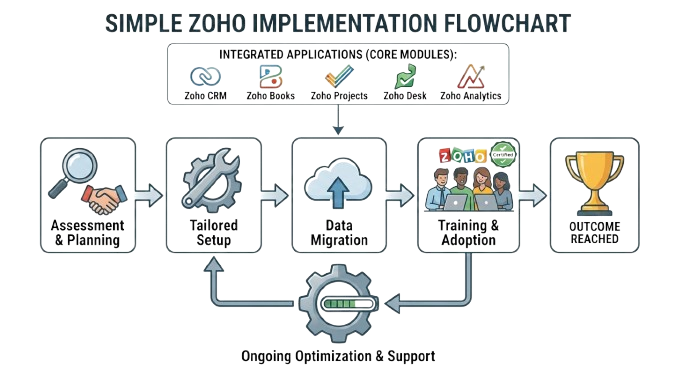
Implementation steps (90-Day execution model)
A phased execution model creates clarity and control.
First 30 days (Foundation): Process mapping and base setup
Next 30 days (Build): System configuration, automation, and integrations using Zoho Flow
Final 30 days (Optimization): Workflow refinement and reporting accuracy improvement
This approach prevents overload, improves adoption, and ensures system stability.
Zoho implementation architecture
A successful Zoho implementation operates across four layers:
- Process
- Data
- Automation
- Insight
Each layer supports the other. When aligned, the system delivers measurable value. When disconnected, performance declines.
Use case (Real scenario)
A B2B services company implemented Zoho CRM without structured planning.
The system captured data but did not reflect actual sales activity. Pipeline stages were unclear, and reporting lacked accuracy.
After restructuring the pipeline, standardizing data, and introducing controlled automation, the system began reflecting real deal movement within 60 days.
Visibility improved, reporting became reliable, and manual tracking reduced significantly.
Himcos approach to Zoho implementation
Implementation success depends on the execution model.
- Scratch implementation focuses on building systems from the ground up
- Fixed scope projects provide clarity for defined requirements
- Hourly engagement supports continuous improvement and optimization
Each approach aligns with different business needs and stages.
For detailed discussions or custom requirements, reach out here: https://himcos.com/contacts-simple/
Book a free 30 min consultation
Businesses experiencing challenges in the first 90 days often require a structured system audit.
This includes reviewing CRM setup, data structure, workflows, and reporting accuracy.
Book your consultation here: https://calendly.com/anuj-himcos/30min
The outcome is a clear action plan to fix gaps, improve system performance, and align operations with business goals.
You can also reach out directly through the contact form:
https://himcos.com/contacts-simple/
Key takeaways
Zoho implementation success in the first 90 days depends on structure rather than speed
Systems built without process alignment struggle with adoption and reporting accuracy
Clear business logic, structured data, and phased execution create measurable outcomes and reduce rework