
In 2026, organizations operate within highly interconnected digital environments where speed, clear data access, and uniform processes define lasting performance. Instead of being just an IT project, automating business workflows now underpins daily operations necessary for cross-departmental effectiveness. Growth brings expansion; yet tasks like authorizing requests, compiling reports, managing purchases, or sharing updates grow harder to track. Where business workflows remain unautomated or only partly organized, delays and misalignments appear throughout company levels.
Despite embracing digital tools, some businesses maintain isolated workflows, a pattern noted by consulting groups like Himcos. When software enters the scene, approval chains may still unfold across emails, spreadsheets, because oversight stays decentralized. Business automation solutions tend to sit outside key operations under these circumstances. As a result, choices take longer, information splits into silos, effort multiplies without scaling insight. Clarity erodes slowly when systems fail to align.
Organizations looking to address these gaps often begin by evaluating their current processes with experts—scheduling a consultation here: https://calendly.com/anuj-himcos/30min can help identify where workflow inefficiencies originate early on.
Table of Contents
Operational friction and process delays
Organizations that delay automating business workflows often experience gradual slowdowns in operational execution. Documents moving manually, along with approval steps and activity notices, bring irregular timing to everyday tasks. With every extra person involved, waiting becomes more likely, particularly across shared processes between teams. Over time, even minor delays, repeated again and again, grow into blockages that affect scheduling and teamwork. What begins as slight lag eventually reshapes how work flows through the organization.
Without business process automation tools, work depends heavily on personal reminders to keep tasks moving. Following up often falls to managers, who check approval progress, gather input across teams, instead of focusing on broader goals. Time spent aligning disjointed data adds unseen expenses to daily operations. Unpredictable steps emerge when procedures lack clear design, making consistent results harder as volume grows.
For companies facing repeated delays or unclear process ownership, structured assessments through a simple contact request— https://himcos.com/contacts-simple/ —can help surface hidden inefficiencies across teams.
Hidden financial impact of manual workflows
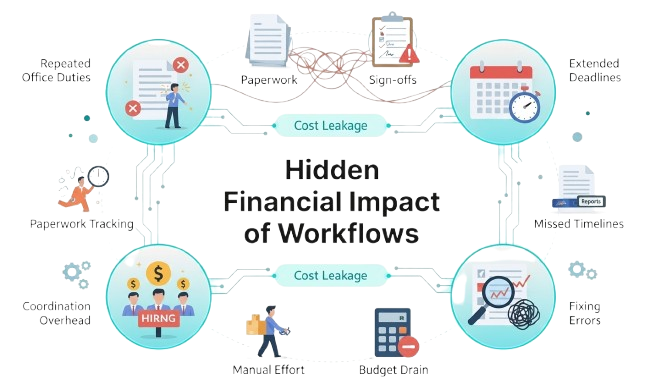
Over time, skipping business workflow automation shows up less as one clear cost. Gradually, expenses built from repeated office duties, extended deadlines, also extra staff hired just to coordinate. What happens is teams add workers to track paperwork, sign-offs, plus reports, tasks systems might do alone. Hidden strain grows where manual effort replaces organized digital handling.
Another hidden financial burden lies in fixing errors. When work moves slowly through manual steps, numbers often go wrong, reports drift off track, rules get misapplied, details slip. A small mismatch pulls people into checks, follow-ups, meetings across departments. These loops grow larger without notice, eating the budget meant for growth. Systems that run on automated business workflow logic ease pressure by handling repetitive jobs with routine operational tasks.
Data visibility and decision-making limitations
Postponing business workflow automation means operational data tends to remain scattered among various platforms and messaging tools. Instead of shared frameworks, departments rely on separate spreadsheets, papers, or reports without aligned updates. Because of this misalignment, leaders face difficulty retrieving reliable metrics promptly. Without unified views, reviewing results takes longer, while decision-making becomes harder due to delayed insights.
Despite limited access to shared data, cooperation across units often suffers. Where business workflows’ automated integration is missing, finance, operations, and client divisions tend to work from separate interpretations of identical processes. As a consequence, metric consistency weakens while report timelines stretch. When systems exchange information through structured digital pathways, clarity improves naturally. Organizational insight grows stronger without depending on manual updates.
When leadership teams struggle with fragmented reporting, it often helps to review data flow architecture with specialists—booking a session here: https://calendly.com/anuj-himcos/30min allows a deeper look into system alignment challenges.
Fragmented data ecosystems
When operations rely on casual messaging instead of systematized processes, disjointed data systems tend to form. Fragmented teams store details in standalone files or private logs, later demanding manual effort to merge them. Because processes lack business workflow automation, getting full updates takes longer than needed. These delays reduce the effectiveness of performance monitoring and strategic planning.
When companies grow more complex, fragmented data systems tend to increase paperwork loads. Because information lives across separate areas, staff often spend hours matching entries, checking performance numbers, one department against another. Without automated business workflow solutions, keeping data consistent depends almost entirely on manual effort. With passing months, such reliance slowly weakens report reliability along with leadership’s ability to respond quickly.
Reduced strategic agility
Quick decisions rely on timely access to accurate work data. When companies skip workflow automation, gathering results across units often takes longer. Information must be combined by hand every time reports are due. This step holds back insight development, making it harder to react swiftly to shifting conditions.
When markets move fast, hesitation costs momentum. Faster insight access tends to appear where automated systems shape daily operations. Responses gain speed when data flows without manual gates. Delays grow more likely if reports pass through layered approval chains. Strategic flexibility shrinks under reliance on outdated summaries. Process tools quietly shift timing advantages toward those using structured business workflows.
Compliance risks and governance challenges
By 2026, oversight bodies expect clear records of decisions, approvals, and daily operations. Where business workflow automation lags, companies tend to rely on documents spread through emails, personal drives, messages. Because information sits apart, checking adherence becomes harder when auditors examine processes.
Approval times, movement of documents, and choices made during operations get logged by systematic automation platforms into unified databases. Because of such logging, oversight becomes clearer through consistent traceability paths. Oversight tasks grow more complex when procedures stay unautomated, since teams often must piece together past actions after the fact. Rebuilding timelines manually raises effort across departments while also introducing exposure to penalties should paperwork be missing.
Where compliance tracking becomes difficult, reaching out via https://himcos.com/contacts-simple/ enables organizations to explore structured audit-ready workflow systems.
Employee productivity and organizational focus
The absence of automation within business workflows significantly influences employee productivity. Throughout the day, staff members spend considerable time managing routine logistics, following up on authorizations, searching for files, moving data across platforms by hand. Attention shifts away from deeper analysis, innovation in offerings, long-term organizational thinking. Such recurring duties occupy mental space better used elsewhere.
Organizations that introduce automating business workflows through consulting partners such as Himcos often observe a gradual shift in employee responsibilities. With tasks such as document routing and approvals handled systematically, manual oversight fades into the background. Instead of tracking progress across departments, individuals find themselves immersed in evaluating performance patterns. Gradually, attention moves from moving information to shaping decisions. Routine gives way to reflection, driven by consistent digital pathways behind the scenes.
Technology investments without workflow integration
Digital tools now support finance, sales tracking, task planning, marketing tasks across numerous businesses. Still, without connecting automated business workflows inside those tools, tech spending brings only minor progress in daily operations. Information moves by hand because systems do not speak to one another, slowing down what modernization was meant to fix. Efficiency lags behind promise whenever workflow automation stays outside core software use.
Despite owning various digital tools, many organisations fail to link them via business process automation tools. Not connected systematically, these systems function in isolation instead of synergy. Coordination suffers, leading to broken workflow patterns across modern tech setups. Efficiency gaps persist because integration is absent, limiting steady improvement in operations.
Isolated software systems
Where isolated software environments form, organizational structures often remain unchanged despite new tool adoption. Though sales groups use CRM platforms, separate systems handle financial records within accounting divisions. Project oversight belongs to operations units running distinct management applications. Information moves between them, mostly updated manually because automated business workflow connections do not exist. These disjointed processes persist even as digital tools multiply across departments.
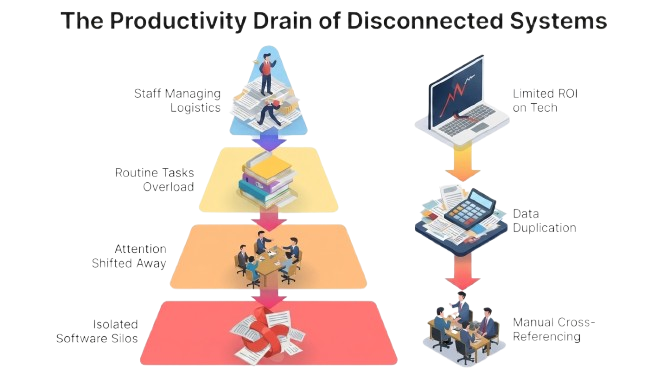
Fragmentation leads to inefficiencies, undermining how much enterprises gain from their tech spending. Records get copied by staff into various systems, while changes require hand-driven coordination across teams. Information flows are shaped by business process automation tools linking platforms using fixed sequences. Without this kind of linkage, operations stay inefficient even when up-to-date software is in place.
Integration gaps and data duplication
Occasionally, disconnected systems create repeated entries during routine operations. When teams update data by hand, variations in customer details or task progress can emerge between divisions. Reliance on manual processes means staff check several sources to confirm accuracy prior to compiling official outputs. Automated business workflows reduce these inconsistencies, allowing consistent results without constant cross-referencing.
With each verification cycle, clerical tasks grow heavier while gaps for mismatched records widen. Data repeated across systems slowly erodes trust in official reports. When business workflows become automated, businesses align their operational details across software environments, errors decline and internal summaries gain steadiness. Eventually, alignment replaces rechecking.
Limited return on digital investments
Productivity gains often follow investments in enterprise software, yet outcomes differ widely across firms. When business workflow remains unchanged, workers still depend on spreadsheets, alongside email chains for task tracking and sign-offs. Even powerful tools underperform if used within outdated routines. Without redesigning how work flows, new technology brings only minor changes to daily operations.
Organizations like Himcos often see businesses running current digital tools without connected procedures. Without automated business workflows, those tools operate separately rather than as a unified system. When processes are clearly defined and paired with automation technology, separate applications begin working together effectively. Coordination emerges where fragmentation once slowed performance.
How Himcos supports automating business workflows
Despite common assumptions, shifting how business workflows inside companies now centers less on tools, more on rethinking routines. Through examination of current methods, Himcos detects inefficiencies embedded within daily operations. Workflow designs then emerge, shaped deliberately to fit multiple team contexts. Alignment between human activity and system capabilities becomes the priority instead of software deployment alone. Strategic value appears when structure follows function, not technology trends.
Using automated business processes, integrated platforms, and oversight mechanisms, Himcos helps companies reshape disconnected operations into unified systems. With organized business workflows, information becomes easier to track, management tasks require fewer resources, one sees improved clarity in decision-making structures. When work settings become more intricate by 2026, those applying structured automation achieve better command over daily functions, along with steadier performance throughout teams.