
By 2026, customer engagement has moved beyond fixed campaigns and one-way messaging. Interaction now unfolds continuously, driven by behavior patterns, situational context, because timing adjusts in real time. Central to this change stands AI-powered marketing automation.
Systems now adapt by watching how people act, then adjusting – learning happens step by step, not set in advance. Interaction shifts over time, shaped by incoming information across linked platforms. What once relied on rigid plans now moves with changing inputs. Progress comes not from scripts, but from constant updates fed by real activity. In practical applications, organizations such as Himcos structure AI marketing automation systems that respond to live behavioral signals instead of static campaign logic.
For businesses looking to implement such adaptive systems, scheduling a consultation can help align strategy with execution: https://calendly.com/anuj-himcos/30min
For businesses looking to implement such adaptive systems, scheduling a consultation can help align strategy with execution: https://calendly.com/anuj-himcos/30min
With rising demands from customers and shrinking focus spans, AI shapes brand interactions online. How companies stay visible now depends on adaptive systems that respond in real time. Engagement shifts where precision replaces guesswork. Relevance emerges not from frequency but from timing. Digital presence means adjusting before users look away.
Table of Contents
How customer engagement is evolving
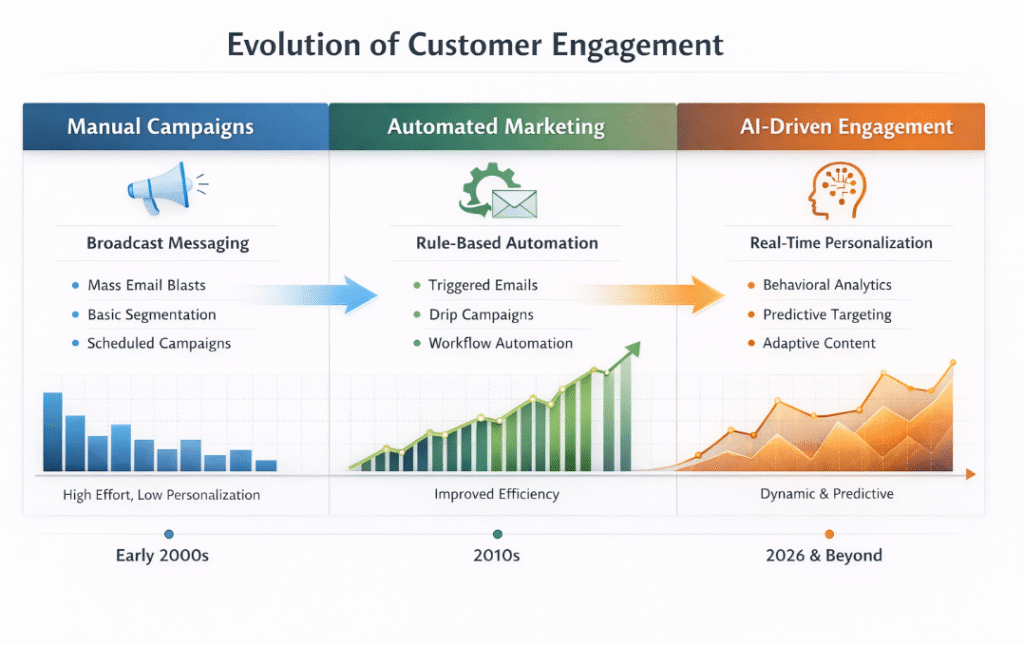
Progress in engagement unfolded across distinct phases. In initial digital efforts, broad exposure mattered most, alongside consistent messaging. As time passed, automated systems improved performance by minimizing hands-on tasks. Still, relying only on speed and output falls short of meaningful connection today.
Shift toward behavior-led engagement models
By 2026, attention turns toward coherence linking messages to intent, timing, and behavioural intelligence. Interaction happens through varied platforms, gadgets, at shifting hours, rarely along straight lines. Fixed processes fail to capture such motion.
Patterns emerge when engagement signals are analyzed through automated systems, not just single occurrences. Because of this approach, customer actions shape strategy more accurately than campaign structures do.
AI marketing automation in 2026
In 2026, AI marketing automation relies on pattern recognition, user behavior assessment, alongside forecasting methods to shape how interactions unfold. With access to past records and live inputs, these tools determine likelihood of response, suitability of material, along with optimal moments for outreach.
Replacing fixed workflows with adaptive logic
Where older marketing automation followed fixed instructions, AI assesses probability alongside situational factors. As learning progresses through feedback patterns, interaction results shift gradually. Performance adapts without explicit reprogramming when exposure to responses increases.
Decision-making through continuous feedback
Decisions form based on accumulated experience rather than static logic alone. Such ability lessens reliance on assumptions while better connecting outreach efforts with what customers actually intend. Alignment grows stronger when actions follow actual behavior instead of expected patterns.
Behavioral intelligence at core
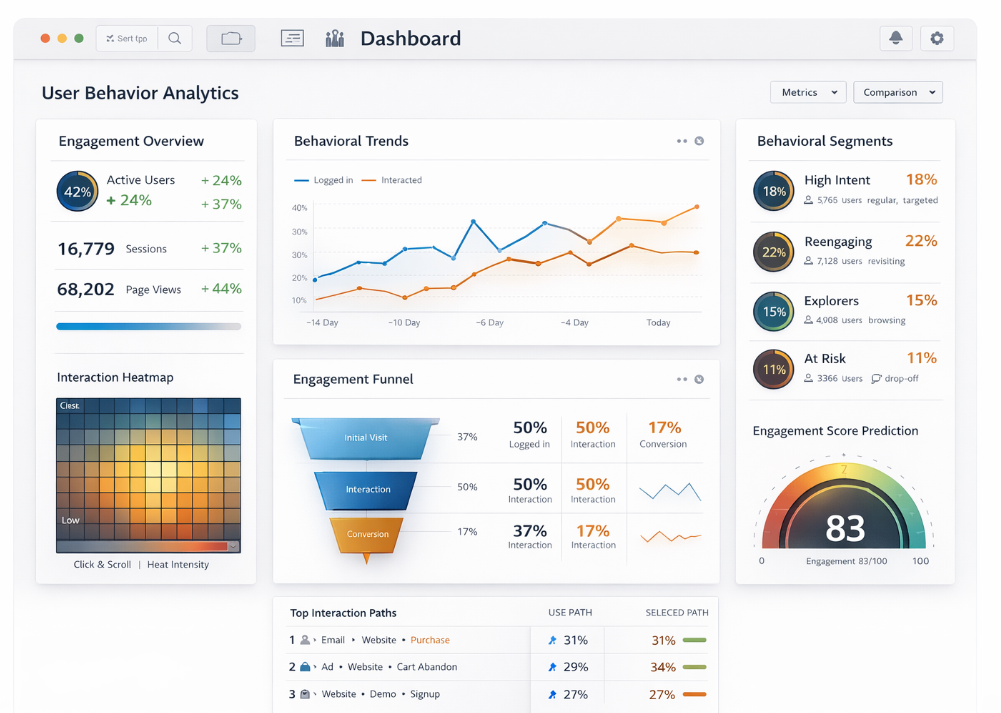
Behavioral intelligence defines how AI marketing automation reshapes engagement. These patterns guide responses beyond simple tracking of steps taken. What appears to shape how engagement is seen includes how often people interact, sequence, hesitation, content depth , followed by shifts across communication platforms. Patterns of curiosity, evaluation, or readiness signaling tend to be detected by AI systems.
This intelligence shapes the path ahead – guiding whether efforts grow, rest, or shift in intensity. What follows is shaped by actions seen, not predetermined steps.
Adaptive segmentation in real-time
By 2026, segmentation moves beyond fixed groups. AI marketing automation continuously reorganizes audiences based on live behavior. As interest shifts, customers transition across different levels of involvement. Communication routes shift through automation, adapting to renewed activity, breaks, or faster progression without manual input.
This adaptability prevents outdated segmentation from undermining engagement relevance. When applied in real settings, firms like Himcos build shifting categories based on actions people take instead of demographic assumptions, which helps interactions adapt faster. Though built differently, these systems respond more closely to how users actually behave.
Context-driven personalization
Nowhere is change more evident than in how tailored experiences are created. Through AI marketing automation, responses adapt based on behavior, engagement history, and interaction patterns. Ultimately, relevance emerges from observation rather than assumption.
Messaging tone, content complexity, and delivery cadence adjust based on how individuals interact rather than who they are on paper. Relevance increases when responses shape communication instead of static profiles. Repetition fades where behavior guides pacing. When context guides interaction, customization expands efficiently, yet demands little hands-on oversight. What changes is how people connect – less uniform, more adaptive by design.
Predictive timing for engagement
At times, success hinges on how soon a message arrives. By reviewing past behaviors, AI marketing automation estimates moments of highest response chance. Optimal moments for interaction emerge when timing follows personal rhythms. With attention as the guide, messages arrive only when focus allows. Systems adjust silently, shaped by behavior instead of rigid plans.
This predictive approach improves interaction quality and reduces disengagement caused by poorly timed outreach. When these frameworks are put into practice, experts such as Himcos may be involved to link forecast-driven scheduling with overall outreach planning.
For tailored implementation guidance, businesses can also connect directly here: https://himcos.com/contacts-simple/
Unified omnichannel engagement
By 2026, communication through email, messaging apps, websites, and digital platforms defines customer interaction. When handled in isolation, such touchpoints may lead to duplication or misalignment. From observed interactions across platforms, AI marketing automation adjusts how messages follow one after another. When a user acts on one platform, that shapes what happens elsewhere. This builds flow instead of repeating steps.
This coordination supports a connected engagement experience without requiring manual oversight across channels. Himcos builds responsive frameworks guided by AI. These systems adapt as customers move, not confined by single-platform logic. Instead of fixed pathways, fluid interactions shape the approach. Direction emerges from behavior, not preset boundaries.
Ai driven journey mapping
Not every path a customer takes moves forward in steps. With AI marketing automation, marketing flows adapt to unpredictable movement patterns across touchpoints. Where users go often becomes clear through automated tracking of repeated actions. Paths shift when choices change, guided by how people respond. At certain stages, activity pauses and then resumes under specific triggers. Movement between steps adjusts itself, shaped by real-time behavior patterns. What happens next depends on what was done before.
Adaptability maintains flow, minimizing detachment due to inflexible processes. As customer actions shift, artificial intelligence enables journey coordination that adjusts without rigid rules. With each interaction, systems respond using learned patterns instead of fixed sequences.
Real-time engagement responses
By 2026, what sets engagement apart is how quickly it reacts. Instead of waiting, AI marketing automation interprets ongoing actions as how someone’s browsing behavior, pauses, or clicks. These instant inputs shape immediate responses, adjusting dynamically without human intervention.
Right away, engagement triggers set new directions. As habits update, suggestions reshape without delay. Messages arrive at different intervals now. Each path step moves in response to what happens today. Immediate feedback shortens delays, enhancing how actions match outcomes.
Measuring engagement through behavior
Over time, patterns in user behavior emerge more clearly through AI marketing automation systems. Rather than relying solely on single-point data, insights develop from repeated actions observed continuously. A shift occurs when repeated observation reveals signs like declining responsiveness, content saturation, or reactivation likelihood. What once was a momentary check transforms into tracking how people act over time. From these observations, adjustments follow, before the campaign ends. A different pace emerges when learning shapes progress early.
Managing engagement fatigue
What often begins as strong interest can fade without notice. When responses grow weaker over time, systems trained to detect shifts take note. Patterns that once showed activity now signal slowing attention. Recognition of these changes happens before participation drops sharply.
Systems reduce frequency, adjust channels, or pause outreach automatically. Engagement remains present without becoming intrusive. Fatigue-conscious engagement methods become part of automated systems through Himcos, guiding sustained connections instead of brief surges in activity.
Data structure and accuracy
When data lacks uniformity, AI performs less accurately. Precision in interaction weakens wherever information gaps exist. For effective AI in marketing automation, data must flow together through consistent tracking methods. When information is accurate, understanding user actions becomes more dependable. What matters most shows up clearly only when inputs are uniform across systems.
When putting plans into practice, Himcos focuses on organized data setups that enable precise interaction analysis as well as consistent AI training results.
Scaling engagement effectively
As user bases expand, maintaining meaningful engagement becomes increasingly complex. Manual systems struggle to keep pace as behavioral patterns multiply and interaction paths diversify. With growing data volumes, AI-driven learning models adjust engagement strategies progressively, responding to shifts in behavior rather than relying on fixed logic. Interaction rules evolve through continuous pattern recognition across expanding datasets, allowing responses to remain relevant as scale increases. This adaptive approach prevents engagement quality from declining under operational pressure. By learning from accumulated behavior, AI marketing automation sustains consistency and relevance, ensuring that growth does not dilute the experience but supports stable, responsive engagement across large and dynamic audiences.
Ethics in AI-driven engagement
Trust grows where actions are clear, choices respected, one step at a time. By 2026, how systems handle information shapes their credibility, ethics guide each move forward. Within set limits, AI marketing automation functions to align results with responsibility. Behavioral understanding shapes engagement methods, yet compliance remains central. Though performance matters, adherence to rules guides each step forward.
Consistency in actions builds reliable connections over time. When people see dependability, their involvement tends to last. Longevity in partnerships often follows from steady behavior. Trust acts quietly but shapes lasting outcomes.
Challenges in AI engagement strategies
While AI marketing automation enables more responsive and behavior-led engagement, its effectiveness depends heavily on how systems are designed, governed, and maintained. Challenges emerge not from the technology itself, but from how data, automation logic, and strategic oversight interact over time. Without careful structure, adaptability can drift away from relevance and responsibility.
Data readiness and integration complexity
AI marketing automation relies on continuous behavioral signals drawn from multiple platforms. When data sources remain fragmented or inconsistent, learning models lose accuracy. Gaps in tracking, delayed synchronization between systems, or uneven data standards weaken the reliability of behavioral interpretation. As engagement decisions depend on pattern recognition, incomplete inputs can lead to mistimed responses or misaligned personalization. Ensuring unified data structures and consistent integration becomes essential for maintaining engagement precision.
Over-automation and loss of strategic control
As automation becomes more capable, the risk of disengagement through over-automation increases. Systems that adapt without regular evaluation may continue optimizing based on outdated or narrow signals. Without human oversight, engagement logic can drift from brand intent, tone, or ethical boundaries. Strategic review remains necessary to ensure automation supports long-term relationship building rather than short-term efficiency. Balanced governance allows AI-driven engagement to remain adaptive while staying aligned with organizational values.
Customer engagement beyond 2026
Still shifting, customer engagement takes new shapes over time. Through AI marketing automation, understanding of behavior grows clearer. Predictions become more accurate under these conditions. Interaction methods adjust themselves with greater precision. Foundations form slowly, yet remain essential.
When organizations support organized frameworks, their ability to adjust grows alongside advancing AI. Clear data handling becomes more valuable over time under these conditions. Progress does not wait; preparation influences outcomes silently yet consistently. Learning patterns may soon shape engagement more than planned timelines do. Over time, methods adapt where routines once dictated flow.
Where customer engagement is headed next
By 2026, AI marketing automation has altered how brands interact with customers. Behavior patterns shape these interactions instead of fixed strategies. Timing adjusts itself based on user activity. Relevance emerges through context, not pre-set rules. What matters most is responsiveness to real-time signals.
From segmentation and personalization to journey orchestration and fatigue management, AI-driven systems influence every stage of engagement. Success depends on structured implementation, responsible data use, and strategic oversight. With careful use, AI marketing automation adjusts to how people interact, maintaining connections over time within shifting online spaces.
To explore how AI marketing automation can be applied to your business, you can book a strategy session here: https://calendly.com/anuj-himcos/30min or reach out directly via https://himcos.com/contacts-simple/