
Email has become a defining factor in the way that organizations are structured around authority, information flow, and work coordination. Zoho mail is also adapting to these demands by enhancing administrative authority, improving security best practices, and integrating collaboration into the email inbox. The latest developments reflect a focus on governance, visibility, and work discipline rather than feature enhancements.
Predictability in access control draws more attention as companies shift toward Zoho mail. Clarity about who owns each message becomes a quiet priority alongside visibility into exchanges. Outcomes of this kind emerge not from automatic setups but through deliberate design. When configurations follow a plan, alignment grows between tools and teams. Support arrives through collaboration with firms like Himcos, which bridge software functions with organizational layers. Regulatory needs shape part of this process, just as future workflows influence choices today. Structure, slowly built, underpins how well systems serve people over time.
Table of Contents
Admin controls supporting organizational structure
With Zoho mail, policy setup follows hierarchy rather than personal habits. Rules apply across domains, groups, or roles, uniformity holds firm unless exceptions are needed. Where changes occur, they happen within limits, not freely. Over time, fewer hands-on fixes become necessary. As companies grow or shift shape, oversight remains steady. Control stays structured without constant intervention.
Clarity in duties emerges as user and group handling adapts. Role-based permissions align with job functions, streamlining entry processes, reorganizations, and updates to access. Changes in team composition lead access rights to adjust without delay. As structures shift, email privileges reflect new conditions automatically. Support arrives through tailored admin designs that follow real-world operations, easing setup challenges across months. Implementation flows more smoothly when systems match how work actually happens.
Security enhancements for controlled communication
Security gains depth when threats are examined in layers, not through single filters alone. Before messages arrive, systems study how senders act, what surrounds each exchange, and how files travel. Resistance grows stronger to scams aimed at tricking users, especially those avoiding software flaws entirely. Instead of chasing code weaknesses, attention shifts toward human manipulation tactics embedded in message flow.
Messages remain protected while moving between systems or sitting at rest, covering both inside and outside exchanges. Through tighter links between monitoring access and how long information stays saved, oversight becomes possible under one framework. Rather than treating protection as an add-on shield, Zoho mail integrates it into broader control practices.
Collaboration features embedded in daily workflows
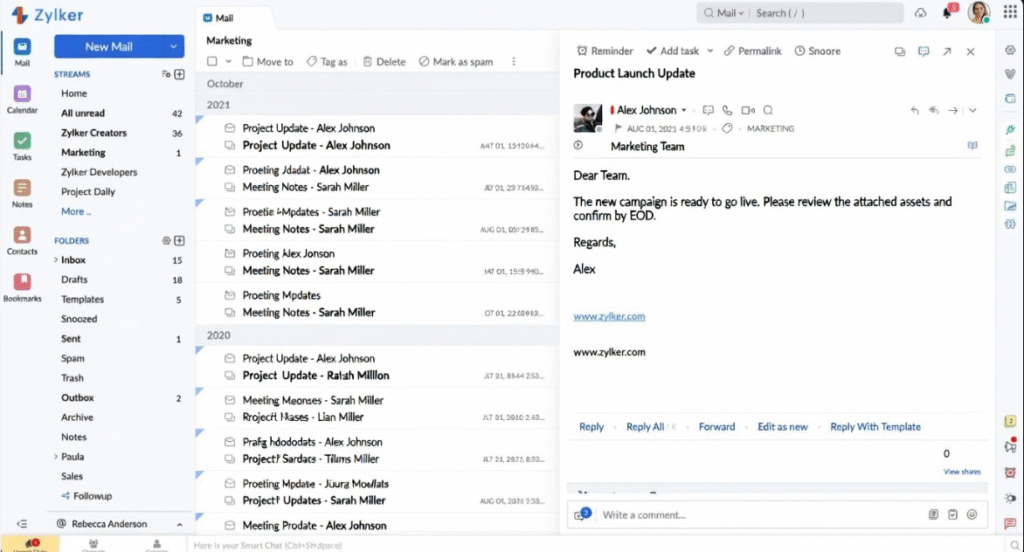
Zoho Mail brings people together through unified messaging within the workspace, avoiding scattered interactions across separate platforms. With shared access to specific email addresses like those used for support, finance, or daily activities, groups handle correspondence without confusion about who replied or what remains open. Coordination stays clear because each member sees updates in real time, reducing overlaps and missed tasks.
With built-in chat linked to email threads, team members share progress notes, resolve uncertainties, or delegate tasks without sending forwarded replies. Information context persists naturally, outside correspondence follows usual patterns, decision trails stay visible internally. Depending on how large a group is, how intricate its processes run, and how much messaging occurs daily, Himcos tailors such collaborative functions accordingly.
Shared mailboxes for coordinated team communication
One mailbox, many hands – Zoho Mail enables group access under shared addresses where actions stay visible. Whoever handles messages does so within set permission levels, limiting chaos through clear boundaries. Oversight of message handling prevents two people answering the same note twice. Coordination gains strength when reply trails remain open to view. Roles shape access, shaping how each person interacts. Structure follows function: clarity comes from limits, order from assigned duties.
Contextual conversations that preserve message history
Attached to messages, contextual threads allow teamwork within email boundaries, preserving the initial content intact. Through these links, staff exchange progress notes, define duties, one after another, maintaining alignment with the originating correspondence. Instead of scattering replies, conversations remain anchored, cutting down on repeated forwards piling up over time. With discussions bound to their roots, clarity grows quietly across departments and hours apart. Collaboration stays tied where it begins, moving forward without detaching from context.
Visibility and reporting for administrative awareness
Beginning with a closer look at user habits, Zoho mail enhances its reporting tools to reflect actual engagement across domains. From message frequency to how often accounts are accessed, data paints a clearer picture over time. Instead of guessing, decisions now follow patterns seen in real interactions. Clarity emerges where estimates once stood.
Logs track admin tasks along with security incidents, yet never reveal messages themselves. Oversight becomes possible through such transparency, enabling audits, ensuring responsibility, supporting compliance, all without crossing privacy lines. With Himcos, businesses make sense of these records by connecting insights to governance aims, turning raw data into meaningful supervision rather than mere observation.
Governance and long-term data management
Clarity about access duration and usage terms shapes strong communication oversight. Where policies or legal standards apply, Zoho mail enables structured handling of message lifespans. Automation enforces these settings without waiting for individual actions or routine maintenance steps.
Readiness for audits, conflicts, or probes improves when legal review functions are in place. Because search accuracy increases, essential messages can be retrieved while daily activities continue uninterrupted. With organized hold systems, data stays accessible yet contained during active cases. Email takes on the role of governed records under Zoho mail, moving away from chaotic storage.
Retention policies based on organizational rules
With Zoho mail, how long messages stay is shaped by organizational rules instead of user choices. Following set durations, emails stay accessible then shift into automated handling. Unwanted buildup tends to shrink when access ends by design. Across teams, outcomes align more closely where retention follows structured guidelines. Risks tied to unchecked email piles lessen under systematic control.
Preparedness for review and compliance requests
Authorized groups gain quicker entry to message logs when official inquiries occur, thanks to upgraded evaluation systems. As long as assessments continue, modification or removal of related information is blocked through legal preservation features. With Zoho mail, access leaves a clear trail yet does not interfere with regular messaging flow, enabling firms to meet oversight, inspection, or inquiry demands securely.
Integration and platform alignment
With Zoho mail, identity systems connect more smoothly to workplace tools, enabling steady permissions regardless of platform. Because directories sync directly, adding users, adjusting roles, or removing access happens without manual updates. Email privileges shift in line with organizational changes, minimizing delays caused by stale records. Oversight grows simpler when account status follows defined workflows instead of isolated actions.
With workflow aligned to CRM and operational platforms, communication details transfer across connected systems, avoiding repetition. Because email exchanges link directly to follow-up actions, consistency remains intact throughout procedures. When Zoho mail integrates with wider digital frameworks, companies gain support through unified operations. As a result, messaging becomes embedded within coordinated workflows.
Email as a managed communication system
Still changing, Zoho mail grows beyond basic email through emphasis on control, clarity, time-saving coordination. Oversight tools allow orderly management while security measures respond to current threat behaviors; working together stays simple because shared tasks remain inside the mail environment.
Over time, clarity in access, messaging pathways, and information handling emerges when institutions apply these revisions. Supported by organized deployment guidance from Himcos, Zoho mail fits within operational frameworks and adherence demands – shaping email into a stable channel. Stability grows where structure meets purpose.
How does Himcos help?
With Himcos, email setup follows an organization’s actual hierarchy instead of generic templates. Rather than seeing messages only as communication, configurations match administrative powers, entry permissions, and teamwork functions to existing chains of command, job duties, and oversight requirements. Authority levels, who sees what, and task ownership then appear consistently within daily message practices across units.
By planning security, retention, audit readiness, and platform integration together, Himcos enables Zoho mail to scale without losing control or clarity. As organizations evolve, these foundations allow communication systems to adapt smoothly, supporting compliance, coordination, and long-term operational discipline rather than reactive fixes.