
In 2026, many businesses struggle with CRM systems that are expensive, complex, and difficult to manage. Instead of improving operations, these systems often slow teams down and increase dependency on technical support.
This is where the comparison between Zoho CRM vs Salesforce becomes important. Both platforms are powerful, but they follow very different approaches to cost, usability, and implementation. Choosing the right CRM is not about features alone. It is about selecting a system that supports real business execution without adding unnecessary complexity.
Table of Contents
Quick insights of Zoho CRM vs Salesforce
- Zoho CRM is simpler, more affordable, and faster to implement
- Salesforce is powerful but complex and expensive
- Zoho CRM works best for growing businesses
- Salesforce suits large enterprises with technical teams
What is a CRM system?
A Customer Relationship Management system is a platform used to manage leads, track sales pipelines, and store customer interactions in one place.
Solutions like Zoho CRM and Salesforce act as central systems that connect sales, marketing, and customer operations, ensuring data consistency and better decision-making.
Why are businesses rethinking CRM in 2026?
Businesses are re-evaluating CRM systems because many implementations fail to improve execution. The core issues remain consistent. Systems become too expensive as features scale. Complexity increases with customization. Teams depend heavily on technical experts for even small changes. Instead of enabling operations, the CRM becomes a bottleneck.
This is why the Zoho CRM vs Salesforce comparison is no longer just about features. It is about operational efficiency.
Why do CRM implementations fail?
CRM failures are rarely caused by the platform itself. They occur due to poor implementation and misalignment with business workflows. When systems are over-engineered, teams struggle to use them. When workflows are not clearly defined, automation becomes ineffective. When data is not structured properly, reporting loses reliability.
In the Zoho CRM vs Salesforce context, complex systems like Salesforce often increase these risks, while simpler systems like Zoho CRM reduce them.
What is the right CRM approach in 2026?
The right CRM approach focuses on usability and execution. Businesses need systems that are easy to manage, quick to deploy, and capable of automating real workflows. The goal is not to build the most advanced system, but to build one that teams actually use every day.
This is where Zoho CRM stands out in the Zoho CRM vs Salesforce comparison.
Zoho CRM vs Salesforce: Core differences
At a fundamental level, the difference lies in philosophy. Zoho CRM is designed for simplicity and speed. It enables businesses to start quickly and scale gradually. Salesforce is designed for large enterprises that require deep customization and have dedicated technical teams.
This difference impacts cost, implementation time, usability, and long-term scalability.
How much does each CRM cost?
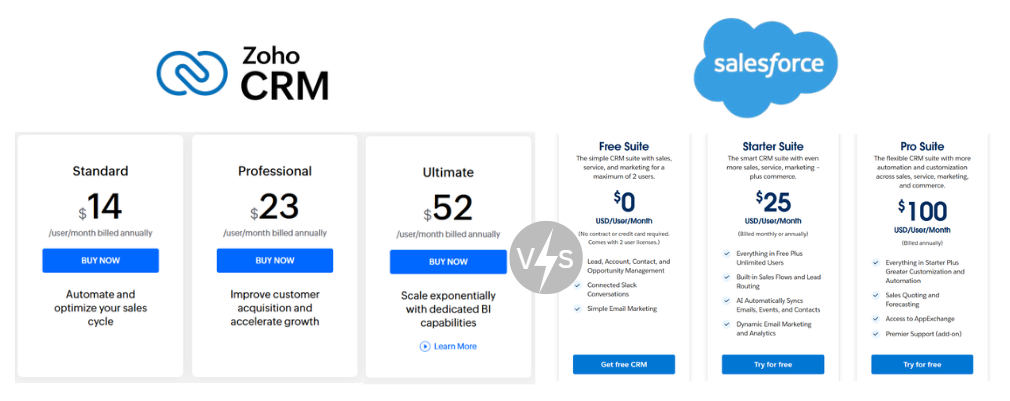
Cost is one of the biggest differentiators. Zoho CRM offers predictable pricing, starting with a free plan and scaling affordably. Most features, including automation and AI, are included within standard pricing tiers.
Salesforce, while starting at a lower entry price, becomes significantly more expensive as businesses add features. Advanced capabilities such as AI and automation often come at an additional cost. In real scenarios, businesses working with Himcos frequently reduce CRM expenses significantly after switching to Zoho CRM, freeing up budget for growth initiatives.
How does AI differ in Zoho CRM vs Salesforce?
AI plays a central role in modern CRM systems. Zoho CRM includes an AI assistant called Zia, which is built directly into the platform. It helps teams predict deal outcomes, identify risks, and automate decisions without requiring additional setup.
Salesforce offers powerful AI capabilities, but they are often part of a broader ecosystem that requires configuration, expertise, and additional investment. The difference lies in usability. Zoho CRM delivers practical AI that the team uses immediately, while Salesforce provides advanced AI that may require technical support.
Which CRM is easier to use?
Ease of use directly impacts adoption. Zoho CRM is designed for business users. Teams create workflows, automate tasks, and manage pipelines without relying on developers. Features are structured in a way that aligns with day-to-day operations.
Salesforce offers flexibility but often requires trained administrators or consultants to manage workflows and configurations. For most growing businesses, Zoho CRM provides a smoother experience with faster execution.
Which CRM is faster to implement?
Implementation speed determines how quickly a business starts seeing value. Zoho CRM typically is deployed within a few weeks. Its structured setup process and intuitive interface allow teams to get started quickly.
Salesforce implementations often take several months, especially for customized environments. This increases both cost and time before ROI is achieved. Himcos follows a structured implementation approach that helps businesses go live with Zoho CRM faster, ensuring quicker operational impact.
CRM system framework: Zoho CRM vs Salesforce
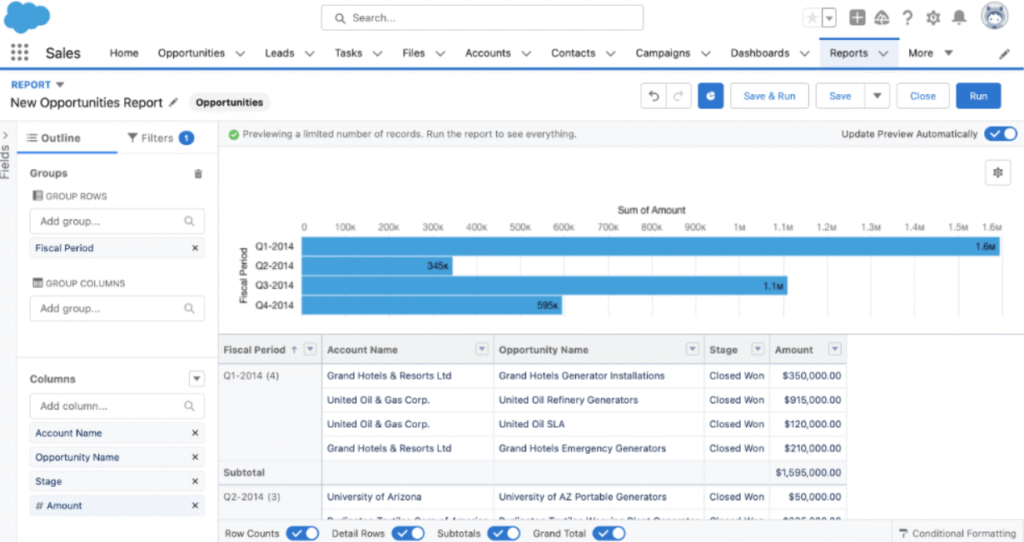
A well-designed CRM operates across three layers. The first layer is data management, where customer information is structured and stored. The second layer is process automation, where workflows reduce manual effort. The third layer is analytics, where insights guide decision-making.
Zoho CRM integrates these layers in a unified and simplified way. Salesforce, while powerful, often requires additional tools and configurations to achieve the same level of alignment.
Himcos implementation
The practical difference becomes clearer through real implementations. In healthcare organizations, Himcos uses Zoho CRM to manage patient workflows from initial contact to billing. This reduces manual coordination and improves data accuracy.
In automotive businesses, Zoho CRM is used to track leads, automate follow-ups, and connect sales with inventory systems. This improves visibility and increases conversion rates. These examples show how Zoho CRM performs effectively in real operational environments.
How does each CRM scale?
Scalability is essential as businesses grow. Zoho CRM allows businesses to expand gradually. Through Zoho One, companies are now able to connect CRM with finance, HR, and marketing systems within a single ecosystem.
Salesforce is also scalable but often becomes more complex and expensive as the system grows. This makes it harder for mid-sized businesses to manage efficiently.
Key takeaways
The Zoho CRM vs Salesforce comparison reveals a clear pattern. Zoho CRM offers a balance of affordability, usability, and speed, making it ideal for growing businesses. Salesforce provides deep customization but requires higher investment and technical expertise.
The right choice depends on whether a business prioritizes execution simplicity or advanced customization.