
Within healthcare settings, intricate systems manage vast amounts of data while striving to meet growing demands for precise care and smoother operations. With each appointment, details emerge accumulating steadily into comprehensive health profiles over time. Although rich in potential, making full use of such information often proves difficult due to scattered formats and inconsistent access. To address these barriers, synthesized patient medical history assemble disjointed notes into coherent narratives, offering clinicians a streamlined view that aids judgment without overwhelming detail. Such clarity arises not from new data, but from reorganizing what already exists.
Beginning with patient records, Himcos integrates AI into everyday clinical processes. Where most systems add complexity, this method simplifies review by reshaping raw data into concise summaries. Instead of overwhelming staff, it delivers clear insights at the point of care. Through structured analysis, historical details become immediately useful. As treatment progresses, updated summaries follow the patient across departments. Rather than relying on manual entry, automated interpretation maintains accuracy. Over time, decision-making gains consistency due to reliable access to key health events. With reduced effort spent tracking past notes, clinicians focus more on current needs. Because alignment with workflow matters, design follows actual usage patterns. From admission to discharge, information flows without disruption.
Table of Contents
Clinical documentation complexity
Years shape how medical history records grow through visits, therapy shifts, test outcomes, also doctor insights. Despite digital systems gathering these details, older data piles up, creating fresh challenges. Notes differ widely in style, word choice, detail level shaped by who writes them, their field, situation.
Cognitive burden of manual clinical record review
Under pressure to work quickly, clinicians must go through large volumes of information. To find key past events, they move carefully across progress notes, test results, discharge papers, along with advice from specialists. The need to do this by hand adds mental strain while shrinking opportunities for face-to-face care. Though thorough, the method takes effort away from being present with patients.
Purpose-Driven Clinical Summarization Without Workflow Disruption
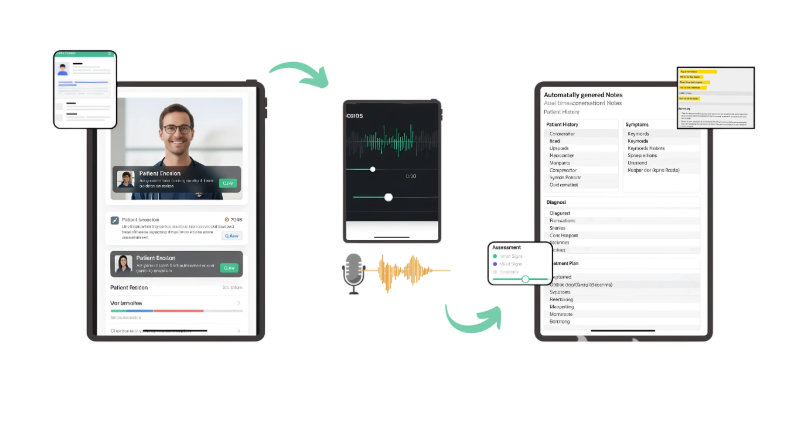
By integrating a systematic summarization method, Himcos translates patient records while preserving current AI clinical documentation frameworks. Rather than displaying unprocessed details, it groups key elements tied to clinical decisions, producing brief summaries that enable quicker analysis and better understanding. Information flows more effectively when relevance is emphasized through selective structuring. Clarity emerges not from volume but from intentional organization. The system operates alongside established tools, avoiding disruption. Meaningful patterns become visible where context guides presentation. Summarized outputs reflect purpose-built design focused on utility.
Purpose of clinical summarization
Clarity takes priority when summarizing patient histories using Himcos. Rather than reducing length, the emphasis lies in shaping medical history details into a logical sequence. What emerges is a narrative that mirrors the progression of health over time. Meaningful connections between events guide how information appears. Coherence becomes possible when structure follows clinical relevance. Through organized presentation, the full picture remains intact.
Himcos applies advanced medical language processing as part of its AI clinical documentation approach to analyze both structured and unstructured data within patient records. From scattered entries emerge clear outlines of conditions, treatments, prescriptions, sensitivities, test patterns, and visit histories shaped into cohesive overviews. These compilations show how health factors evolve across visits. What these summaries offer is a way to assist clinicians just prior to detailed chart review. Instead of standing in for complete documentation, they function as starting points by allowing quicker grasp of background details without distortion. Their role emerges not as substitutes, but as frames shaping early understanding.
System integration approach
Built for compatibility, Himcos aligns its patient medical history summary with current electronic health records. Since healthcare providers typically operate fixed workflow environments, changes that interfere with operations raise notable hesitation when introducing new tools.
Beginning with established databases, Himcos employs protected transfer methods to gather information. From patient narratives to lab outcomes, material flows in unchanged from its initial form. Rather than modify source entries, clarity emerges via organized clinical overviews. Integrity remains intact due to non-invasive handling throughout the process.
Operating inside established frameworks, enables integration with minimal disruption. Familiar tools remain in place for clinical staff, yet enriched through intelligent data analysis improving overall function. While workflows stay consistent, access to processed information elevates daily practice.

Faster clinical review
Faced with tight timelines, clinical settings rely on quick judgments. During office visits, hospital check-ins, urgent assessments, or when handing off care, medical staff need immediate information about a person’s medical history. With Himcos, reviewing patient medical history takes less time because key details are grouped into clear summaries. Rather than moving through several records, medical professionals see condensed overviews; these include prior diagnoses, how patients reacted to therapies, along with current care factors. All pulled into one cohesive report.
Greater speed in handling tasks improves concentration when working with patients. Because less effort goes into searching files, more mental space opens up for decision-making and dialogue. With assistance from AI clinical documentation, the quality of each encounter rises quietly but steadily.
Care continuity support
When care is delivered between teams, confusion takes root without clear updates. Professionals on different schedules must rely on what was recorded, not what was said. Despite differing users, Himcos maintain uniformity through structured summaries. These records preserve current medical details alongside key past events. A common framework emerges, shaped by real-time updates and longitudinal data. Through consistent formatting, clarity persists across care settings.
When shifts change, brief summaries lessen reliance solely on spoken updates. Well-structured records help teams stay aligned while limiting differences in understanding. Safer, smoother care often follows from consistent written notes instead of voice-only exchanges.
Reduced cognitive load
Still, paperwork weighs heavily on medical professionals’ energy levels. Processing health records manually calls for constant focus, repeated checking, this adds up mentally. What follows is often exhaustion from relentless detail work. By streamlining how past records are interpreted, Himcos lessens the need for extensive manual entry. Rather than rewriting patient histories at every visit, medical staff review consolidated summaries. Automation supports consistency without sacrificing precision, relying on structured AI clinical documentation practices.
When details appear in familiar patterns, mental effort tends to lessen. Arranged by time and topic, summaries through Himcos simplify understanding for medical professionals. Attention moves naturally from gathering facts to assessing individuals and organizing care.
Specialty-aware clinical context
Not every medical field weighs patient background the same way. Where one area focuses on symptoms, another might need timelines instead. Details in surgery matter less in mental health settings. Tailored information often works better than broad outlines. Specific demands shape what counts as relevant medical history.
Depending on the situation, Himcos adapts how it summarizes a patient’s medical history. In managing ongoing conditions, patterns in medication use often matter most. When preparing for surgery, past procedures become more significant. The focus within each summary shifts quietly- guided by purpose and field of practice. Relevance reshapes structure without notice. Flexibility in structure means Himcos fits various medical settings while avoiding fixed templates. At the core of each medical history summary, patient care context takes priority.
Privacy and compliance
When managing information about patients, HIPAA compliance with rules protecting personal details is important. At each point in summarizing medical history, safeguards are built directly into the process by Himcos. De-identified sensitive markers follow protocols consistent with health information safeguards. Where permitted staff gain entry, ensuring alignment with institutional oversight policies.
Depending on policy needs, Himcos works within private cloud setups or local infrastructure. Where data sensitivity matters, institutions retain oversight without losing access to modern AI clinical documentation tools.

Documentation consistency
With manual documentation, each person’s style differs along with how much detail they include. As months pass, these differences make it harder to understand or match up information between one patient’s notes and another’s. Through uniform summary layouts, Himcos helps align documentation practices. Because narrative structures repeat predictably, clarity improves when information moves between units.
Stability in format aids internal evaluations, cooperation across specialties, one task at a time. When summaries follow familiar patterns, attention stays on patient details, not layout variation.
Clinical insight enablement
From structured summaries generated through Himcos, wider analysis efforts in health institutions gain support. As patient medical history gets arranged into defined groups, spotting recurring patterns across large groups grows easier. What emerges is a clearer path toward informed observations when information follows consistent formats.
Improving quality oversight with consistent clinical summaries
Through summaries, past information becomes easier to access for quality efforts. As a result, leaders observe care pathways more clearly. Patterns in operations emerge when outcomes are reviewed over time. What once seemed fragmented now appears structured through consistent documentation.
Transforming fragmented records into actionable clinical insight
From scattered records, meaning emerges when Himcos applies AI clinical documentation. Insight forms not just by collecting data, but through structured interpretation of patient histories. Value appears where raw entries transform into usable knowledge. Clinical information gains purpose once patterns are identified systematically. What was once fragmented now supports clearer understanding across care settings.
Impact on patient experience
Even when unseen, summaries of a patient’s clinical past shape how care feels. Because records are reviewed faster, conversations during visits become more precise. When doctors grasp medical history quickly, time spent on details grows shorter. With fewer screen interactions, clinicians focus longer on patient interaction. When care teams align on a patient’s past, consistency in treatment grows across appointments and units.
Focused processes shape clear outcomes at Himcos, which quietly influence how patients feel about their experience. Trust builds when systems work without noise, behind the scenes. Confidence emerges not through claims, but consistency in delivery. Satisfaction grows where confusion fades and purpose remains visible. Every streamlined step becomes part of a quieter assurance felt over time.
Himcos within digital healthcare strategy
Within Himcos, summarizing a patient’s medical history forms one element of an integrated approach to digital health systems. Alongside current medical technologies, it aligns with efforts aimed at improving both operational flow and data clarity. What emerges is less about standalone innovation and more about structured continuity across care environments. A focus on Himcos often reflects an intent toward systematic records, precise medical communication, because outcomes rely increasingly on documented evidence. Such alignment tends to reinforce trust within healthcare settings due to consistency in practice, where efficiency evolves gradually alongside strategic goals.
Over time, records of patient health details transform into tools that support ongoing refinement instead of existing in isolation. What begins as simple documentation gradually gains purpose beyond initial use through repeated application. Gradual shifts in usage reveal functions never intended at creation. Purpose expands quietly when attention remains consistent. Value emerges not from design but from repetition and context.
Supporting sustainable organizational growth
When clinics grow, paperwork multiplies. Instead of slowing down operations, Himcos adjusts to rising demands quietly behind the scenes. Growth brings pressure; this system absorbs it without disruption. When data grows, summarization methods adjust smoothly, needing little extra manual work. Because of this ability to scale, healthcare settings maintain steady routines, keep attention on patient care, and still hold consistent staffing levels as time passes.
Over time, record-keeping grows more consistent while exhaustion declines. Care teams connect with greater ease as networks widen. Stability in processes emerges alongside clearer communication pathways.
How Himcos brings structure to medical history
What sets Himcos apart is its ability to convert broad collections of patient data into organized clinical narratives that fit smoothly within everyday medical processes. By means of AI clinical documentation analysis, protected connectivity across platforms, and flexible configuration, useful information becomes available more quickly. A lighter load on recordkeeping follows as a result.
One way it works: consistency gets a boost when choices rely on clear data. Where details matter most, organized medical history helps cut through clutter. Because systems must handle large volumes of notes, artificial intelligence steps in to refine records. Quality of treatment may rise under such support. Efficiency follows naturally where processes run without unnecessary delays. With less mental load on staff, focus shifts toward patient needs. From the moment records began piling up, simplifying them became important. Himcos steps into that space, not by chance but through deliberate design, guiding institutions as information loads increase unexpectedly. Precision follows naturally when tools align with real needs. Confidence emerges where chaos once slowed decisions down.