
Messages often turn into scattered records of what needs doing. Because discussions stand in for processes, clear steps vanish into individual routines. As replies pile up within chains, decisions lose structure. In time, talking begins to carry out tasks – yet oversight does not follow. With Zoho Mail setups, this change creeps in when groups rely more on chat than defined entry points. What arises is a misalignment in structure: tasks proceed through email practices instead of defined procedural frameworks. During oversight evaluations led by Himcos, Zoho repeatedly functions as the primary operating layer – even though it was never designed to manage unchecked assignment control.
Inside Zoho Mail lies a quiet function: turning emails into tasks. This shift works deep within the system’s design. Just switching it on will not fix underlying flaws. Unless clear methods exist for use, responsibility must be outlined, along with links to reporting systems. Scattered messages create unclear duties. When ownership blurs, actions follow no pattern. Inconsistent actions warp how results appear in reports. Lasting order emerges only when Zoho’s mail follows set policies instead of personal choice.
Table of Contents
Process misalignment inside Zoho Mail
When procedures give way to casual habits, consistency fades. Email chains in Zoho Mail slowly become where approvals form, tasks are noted, because reliance shifts from structure to recall. Standard workflows weaken since follow-ups rely not on rules but on what people remember. Decisions get stored where they should not be, simply due to convenience overtaking design. Policy loses ground when actions hinge on recollection instead of documentation. Although deadlines are often seen differently by each person, they rarely match official performance standards. Coordination shifts toward Zoho Mail even though there is no system in place to ensure compliance.
What follows affects more than overdue assignments. Inside Zoho’s Mail, scattered data blocks clear analysis. Insights vanish when dashboards ignore promises hidden within message chains. Without access to organized progress records, oversight shifts toward informal reports. Structured visibility gives way to spoken summaries. From fragmented operational signals pulled out of mail threads, strategy often takes shape – despite missing full context. Audits regularly uncover the drift when Himcos observes mail stepping into roles meant for controlled workflows, not just message handling.
Structural role of Zoho Mail email-to-task conversion
What happens when messages become tasks? In Zoho Mail, it reshapes how dialogue flows into action. Not about speed – about order. Instead of loose threads piling up, each interaction gains shape through defined outcomes. Structure returns where chaos often rules. Responsibility is no longer implied; it appears by design. Rather than sitting idle, incoming mail feeds a system built on follow-through. The inbox stops being an endpoint. It becomes part of a sequence.
Deployment works only with clear trigger conditions. Within Zoho Mail, conversion logic determines whether a message counts as actionable – ownership assignment follows from that decision, while timing links directly to dashboard outputs. Absent these guidelines, the system serves individual efficiency more than group oversight. A framework like Himcos treats email conversion as a barrier against gradual workflow breakdown.
Realigning execution through structured intake
From every email, a task takes shape inside Zoho Mail – structured, clear. Ownership appears without debate once messages become discrete work items. Deadlines form part of the structure, visible to all involved parties. Status labels guide progression instead of assumptions. Clarity spreads when interpretation gives way to uniform handling. What was once left to personal judgment now follows established patterns. Visibility shifts from private folders into collective oversight spaces. Rules dictate flow rather than urgency perceived at glance.
With structured setups, integration occurs between Zoho Mail and defined service levels. Depending on the task category, deadlines apply without manual input. Completion metrics appear alongside incoming request counts through updated displays. Clear visibility takes the place of hidden messaging paths. Rule definition and enforcement limits take priority when Himcos designs Zoho Mail oversight systems instead of highlighting functionalities.
Data architecture stability within Zoho Mail
Messages left unprocessed in Zoho Mail hold scattered pieces of activity – sign-offs, edits, promises, warnings. Since analytics tools cannot reach raw inbox content, those details stay hidden. Converting emails transforms loose cues into clear records suitable for tracking systems. Dashboards and compliance histories gain reliable inputs once correspondence is restructured. Clarity rises when intent shifts from assumed to recorded.
Through organized implementation, Zoho Mail supports consistent decisions. Because clear patterns emerge, oversight of task flow improves. Instead of relying on summaries, managers observe actual timing and volume trends. Few companies recognize how layout affects information value. When managed with intent, the system channels inputs into analysis streams. Rather than staying separate, messaging becomes part of a broader insight network.
Ownership ambiguity in mail workflows
Unclear ownership often lingers in settings using Zoho Mail. Messages move through groups lacking clear signs of who is responsible. In team interactions where speed differs, duty spreads thin. When workflows lack built-in tracking tools within Zoho Mail, answerability rests on casual confirmation instead of enforced assignment.
What follows affects shared practices. Because responses come after prompts in Zoho Mail exchanges, work rhythms shift toward reactivity instead of fixed schedules. Without clear logs showing who started what or when it ended, judging output leans on perception. Clarity improves through standardized use of Zoho Mail export formats – this occurs mainly if direction comes from higher levels. Oversight managed by Himcos ties tool usage to responsibilities, linking actions to official roles.
Adoption dynamics and behavioral resistance
Still, even efficient Zoho Mail setups lose traction unless supported consistently. Over time, how people use email takes root through individual patterns, not company rules. A forced shift within Zoho Mail often clashes with these deep-seated practices. When expectations about required usage lack definition, users pick and choose, bringing back disarray.
Because adoption falters when Zoho Mail metrics lack alignment with operational oversight, results drift without structured follow-through. Where leaders omit tracking of usage patterns or skip incorporating activity logs into reviews, adherence weakens. Spotty engagement leads to fragmented awareness within departments. Through inclusion of governance dashboards directly into leadership check-ins, Himcos reshapes how consistency is maintained.
Governance metrics embedded in Zoho
Inside Zoho Mail, governance measures support structured behavior. Conversion rates, speed of replies, followed by buildup in pending tasks – these reveal how closely standards are met. Once these figures become part of leadership evaluations, actions grow more uniform over time. The platform shifts toward a process where entry points can be quantified precisely.
A closer look shows consistent operational constraints. Despite heavy activity in mail, slow resolution points to resource limits, not messaging issues. The pattern suggests adjustments should focus on structure. Oversight data from Zoho Mail becomes part of governance through Himcos methods, supporting ongoing control.
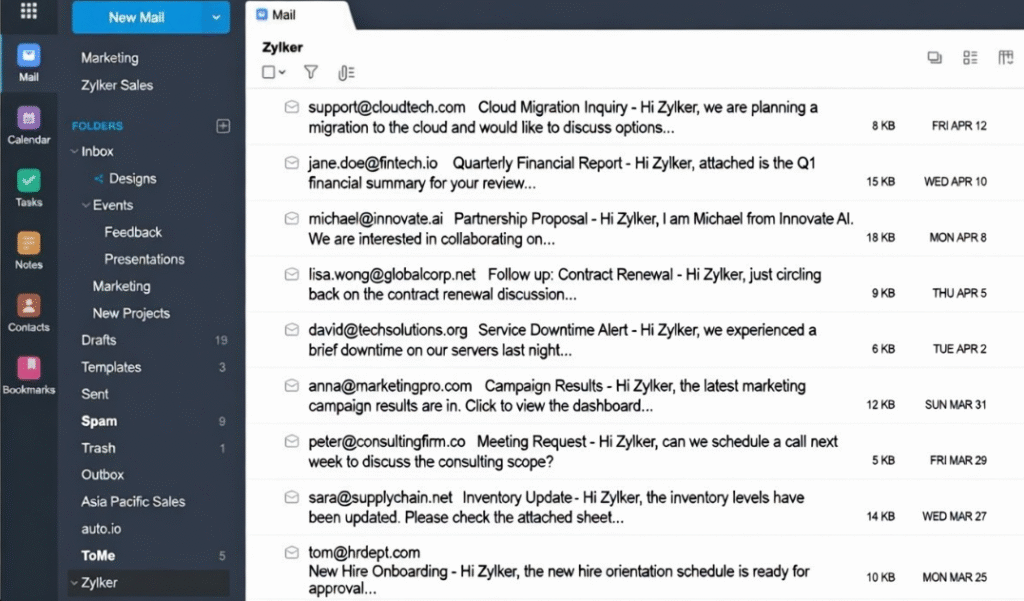
Cultural shift in Zoho Mail usage
What remains last is aligning culture. When workflows rely heavily on email alerts within Zoho Mail, fixed entry rules can feel disruptive. Viewing messages not as archives but signals changes how teams engage. Repetition shapes routine over time. Steady application slowly replaces old patterns.
When visibility shifts to shared dashboards tied to completed tasks, repeated work fades along with last-minute responses. Since everyone sees progress clearly, collaboration across departments grows more fluid despite differing responsibilities. Rather than a sudden shift, Himcos treats alignment with Zoho Mail as a gradual design change woven into policy records and supervision frameworks.
Structural discipline beyond feature activation
What appears at first glance to be simple email reveals deeper effects on workflow speed. Though tools around it are complex, disorganized messages cause delays downstream. A less visible function inside Zoho Mail shapes how tasks move forward. How well that function works ties closely to routine adoption across teams. Without oversight, setup choices tend to repeat past misalignments.
When Zoho Mail intake matches clear ownership, honest reporting, and unified platform policies, systemic resilience takes shape. More than initial setup, it is structure that holds weight. Long-term benefit arises through established conversion criteria alongside ongoing compliance checks. Under such governance-led conditions, Himcos functions as a design planner and method-focused executor – prioritizing foundational fit instead of surface-level adjustments.
Governance alignment framework by Himcos
Stability within Zoho Mail does not come from turning features on, instead it follows clear management practices. While many companies activate email-to-task functions, few establish responsibility frameworks, monitoring limits, or oversight mechanisms. Without these elements, reliance on such tools fades, shifting work back into unstructured message threads. Long-term consistency emerges only when rules for conversions exist in writing, usage benchmarks are tracked, and executive reports reflect actual system behavior.
Through deliberate design choices, Himcos positions itself as an architectural influence in governance frameworks, integrating Zoho Mail into established procedural systems instead of leaving it isolated. The rollout emphasizes coherence between entry-point rules and layers of responsibility, alert sequences, alongside tracking interfaces. Oversight structures become permanent fixtures when tied to how Zoho Mail functions, allowing message exchanges to evolve into organized actions while avoiding confusion or skewed documentation. With clarity maintained throughout, outcomes reflect intent more faithfully due to embedded control points shaping daily use.