
AI in Zoho One operates based on how data gets arranged, exchanged, and maintained throughout the system. Rather than arising from standalone entries or single tools, insight emerges through patterns seen across links, sequences, and interdependencies among departmental actions. Because sales progressions tie into financial logs, which also relate to support outcomes and operational workflows, a unified picture takes form. From such connections to spanning time and function, the machine learns its context.
Where datasets show irregularities, or software tools operate apart, results grow less accurate. Because of this, outcomes change unpredictably. The strength of artificial intelligence within Zoho One depends upon two pillars i.e., structured information and linked systems. Stability begins only after alignment occurs across inputs and processes. When integration deepens, understanding improves without sudden drops. Himcos builds conditions where insight emerges through coherence, not chance. Such depth forms slowly, built on uniformity others overlook.
You can explore this further through a consultation here: https://calendly.com/anuj-himcos/30min
Table of Contents
Clean data as the foundation for AI in Zoho One
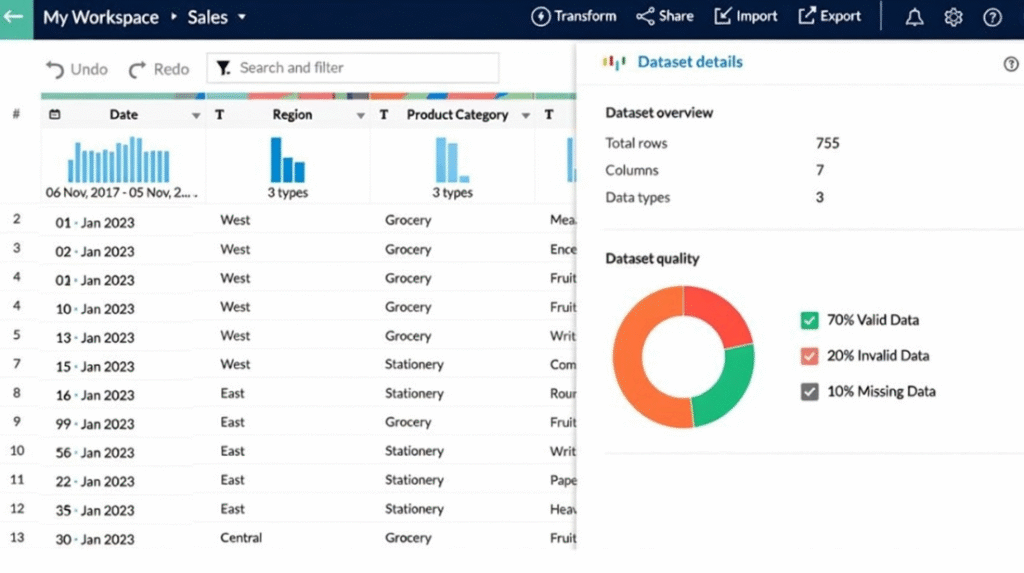
What lies beneath intelligence is a framework of information. From archived entries come every suggested path, prediction, or examined conclusion. Structure and uniformity in these entries allow patterns to emerge clearly. Without alignment in form or definition, artificial systems detect noise instead of signals. Precision within the dataset shapes the difference between understanding and misreading. The quality of input defines what emerges through analysis.
Structure guides every phase of data handling at Himcos, shaping ongoing processes beyond isolated tasks. Focus falls on pathways through which information flows into systems, followed by examination of connections between different platforms. Integrity under increasing volume receives close attention throughout. With this method, analytical capability grows stronger gradually, avoiding breakdowns tied to expansion.
Standardized data structures across applications
A single format for data lets intelligent systems assess entries clearly. Himcos establishes labeling methods, phases, reference details, and categorization rules that follow one model throughout Zoho One apps. Instead of each application using its own version, divisions like sales, finance, support, and management rely on consistent frameworks. With uniformity, comparable entries do not split into disconnected pieces by automated analysis. As patterns build, machine learning detects real shifts over time, measures development precisely, while filtering out irregular fluctuations thanks to stable organization.
Accuracy through controlled data entry
What determines trust in data analysis? It is accuracy alone. Settings within Himcos shape the rules for record flow into Zoho One. Where fields must be filled, inputs restricted, or conditions applied, gaps and mismatches drop sharply. Related data fills automatically when workflows guide the process, reducing repeated typing between systems. With steady precision, thought processes rely on consistent data to measure results. Because real-world operations shape the input, instead of estimates or fragments prediction, sorting tasks by importance, and examination grow more thorough. When details align closely with what happens, insight follows naturally.
Data continuity across business lifecycles
Intelligence improves when it observes progression rather than isolated moments. Records shaped by Himcos move along clear paths, allowing leads to evolve into customers, transactions to connect with service history, and operational records to remain traceable across stages. Past entries adjust smoothly into present systems, keeping sight of what came before. Because threads stay unbroken, artificial intelligence detects intervals between actions, order of steps, how often things repeat revealing habits hidden in timelines that stretch far back.
Connected applications as the context layer for Zoho One AI
Insight cannot come only from data quality. To make the context of information, understanding must include surroundings. Because systems share tasks between teams and processes, clarity grows. When tools interact inside Zoho One, awareness forms through connection instead of separate events.
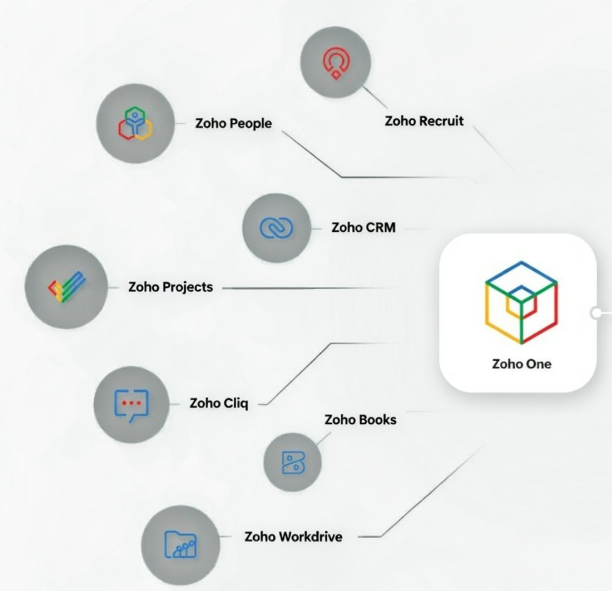
Where operations guide design, Himcos builds connections based on actual workflow patterns. Because processes flow between groups, integration follows those paths capturing triggers and results as they occur. As a consequence, systems form an aligned context for analysis rather than isolated data points. What emerges is less like separate apps, more like one responsive network shaped by usage.
Cross-functional visibility across the platform
Where systems connect, intelligence gains access to cross-functional activity. Through Himcos, actions in CRM combine with financial records, service logs, and operational inputs to form one coherent picture of how an organization operates. As sales advance, they appear next to invoice timelines, just as support cases stay paired with measures of customer worth and involvement. Insight shifts focus from tracking siloed results toward understanding what drives actual impact. Across departments, recurring behaviors surface when data flows without barriers, enabling choices shaped by full situational awareness instead of fragmented signals.
Workflow connectivity and event sequencing
Intelligence gains clarity when timing aligns. Within Himcos, actions in a single system prompt immediate adjustments elsewhere. As deals advance, projects begin with billing activities, resources assigned and all guided by linked sequences. When status shifts, connected tools reflect changes instantly. Consistency emerges through continuous alignment. Following signals in real time, intelligence assesses active environments, not prior snapshots. As sequences unfold, artificial reasoning adjusts within pivotal shifts – capturing motion as it forms, not after settling.
Process-led integration design
Following structured procedures takes priority over ease of tools when combining systems. Before linking software, Himcos charts the flow of tasks among groups. Dependencies, order, and ownership shape every connection made. Through this approach, awareness emerges from live workflows as they progress. Understanding grows by tracing how results come into being, aligning digital actions more closely with actual performance.
Governance and optimization as AI stability mechanisms
Growth within organizations shapes how AI functions over time. When team size grows, so does variation in workflows, complexity follows. Absent clear governance, control over data fades while connections between systems slowly lose alignment. What holds everything steady is ongoing attention, not one-time setup decisions.
Ownership frameworks shape how Himcos operates within Zoho One settings. Through structured access controls, oversight remains consistent even amid growth. Review intervals follow set patterns, ensuring adjustments happen regularly. System integrity stays intact as usage expands. Alignment between analytics and actual workflows is maintained over time. With each phase, clarity supports function without disruption.
Data ownership and access discipline
Responsibility for creating, modifying, and approving records stems from clear ownership. Where roles shape access, collaboration exists without losing traceable accountability. Visibility managed tightly prevents inconsistencies spreading between teams. Even under rising workloads, focused boundaries keep analysis sharp. Audit trails grow stronger when ownership is structured, reinforcing confidence in results over time.
Continuous system review and refinement
Changes in how the system behaves follow user activity trends. During regular evaluations, Himcos examines accuracy of information, efficiency of processes, and consistency across connected components. When misalignment appears, corrections are made ahead of any impact on decision-ready outputs. Process rules adapt through actual use instead of fixed design premises. Such updates help artificial intelligence stay synchronized with daily operations, maintaining useful insights over time instead of focusing only on immediate gains.
Business outcomes enabled through Himcos-led structure
Under such conditions, organizations see gradual development of systems, moving beyond isolated automated tasks. What emerges from analysis captures full operational settings, not just fragments of information. Predictions tend to follow actual behavioral trends. Responses from automated functions show understanding of circumstances, differing from fixed rule-based actions.
When leaders see cohesive operational data, collaboration across teams grows stronger because fragmented updates fade away. As organizations expand, clarity persists since insights evolve smoothly, offering choices built on patterned flow, steady context, together with linked understanding instead of disjointed efforts.
If you want to implement such a structured system within your organization, you can directly reach out here: https://himcos.com/contacts-simple/
How Himcos shapes AI-ready Zoho One environments
Within Zoho One, AI follows the underlying framework. How information is arranged determines understanding. The links between tools define the situation. Rules in place support ongoing function.
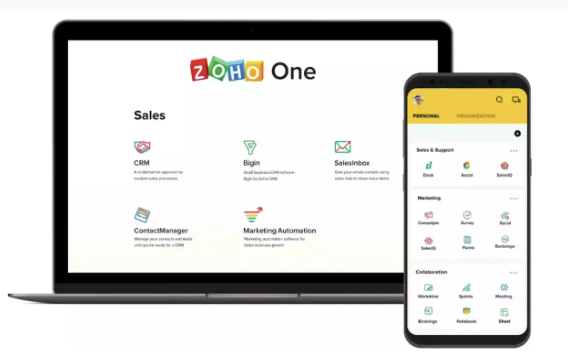
What drives Himcos offerings lies in core principles. With structured data design shaping outcomes, Zoho One evolves into a reliable system for insight. Because processes guide connections across functions, efficiency gains emerge over time. When refinement continues without pause, clarity strengthens within operations. From solid frameworks come decisions rooted in consistency, not just speed. Sustained analysis follows naturally where foundations are sound.
To get started with a tailored approach, book a session here: https://calendly.com/anuj-himcos/30min or submit your requirements through the contact page: https://himcos.com/contacts-simple/